


BANANA FIBER _ A SUSTAINABLE BIO-BASED ALTERNATIVE TO SYNTHETIC FIBERS
With the phenomenal growth of the global wig and hair extension industry, experts have predicted the market size will reach $13.28 billion by 2026. However, this development comes with serious environmental consequences as most commercial products today are made from petroleum-based synthetic fibers (such as polyester, acrylic, or artificial PVC). According to a report by the World Economic Forum (WEF) [1], in the US alone, about 14,000 tons of synthetic wigs are discarded in landfills every year, taking hundreds of years to decompose and releasing microplastics. In this context, the trend of using natural bio-based materials has become an urgent requirement. Fibers made from banana stems (Musa pseudostem fiber) have emerged as a revolutionary material due to their mechanical structure similar to natural hair, opening up a comprehensive circular solution for the hair aesthetics industry.
The primary attribute underpinning the suitability of banana fiber for hairpiece manufacturing resides in its distinctive biochemical architecture. The constituent composition of raw banana pseudostem fiber typically consists of approximately 57.64% cellulose, 29.05% hemicellulose, and 13.30% lignin. The elevated cellulose content—predominantly concentrated within the inner layers of the pseudostem—imparts exceptional tensile strength and favorable elongation characteristics under mechanical stress. Upon undergoing tailored physicochemical surface treatments (such as alkali treatment via NaOH or bleaching via H2O2), the individualized fiber bundles exhibit enhanced fineness, luster, and drapability. Figure 1 illustrates the morphology, color evolution, and gloss of the fibers following sequential treatment with NaOH and H2O2.
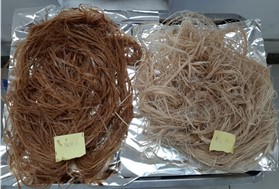
Figure 1. Banana fibers treated with NaOH and H2O2
The delamination and separation of the fiber bundles subsequent to NaOH and H2O2 treatments are demonstrated via scanning electron microscopy (SEM) in Figure 2. 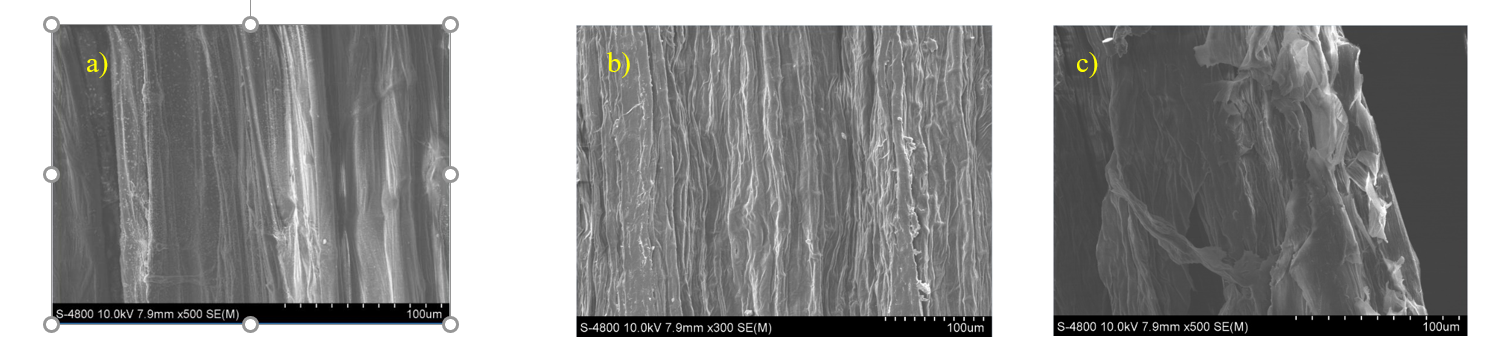
Figure 2. SEM micrographs of fibers: (a) untreated, (b) NaOH -treated, and (c) H2O2-treated
Furthermore, an international patent (Publication No. FR3100108A1) has substantiated that banana pseudostem fibers inherently possess antimicrobial and antifungal properties [3]. When integrated into wigs or cranial mesh foundations, the hollow internal architecture (lumens) of the fibers significantly enhances breathability, thereby minimizing sweat accumulation and microbial colonization. This presents a pronounced advantage over conventional synthetic fibers, which are recognized as primary etiologic factors contributing to scalp inflammation, pruritus, and allergic contact dermatitis among individuals with sensitive skin.
In addition, a critical limitation associated with conventional synthetic hair lies in its deficient thermal stability, predisposing it to thermal deformation or melting under exposure to heated styling appliances. In contrast, refined banana fibers demonstrate remarkably enhanced thermal tolerance. Empirical findings reported by pioneering enterprises such as Cheveux Organique indicate that banana fiber hair strands can withstand thermal stresses up to 400°F (approximately 204°C). Such high heat resistance allows hair stylists to execute blow-drying, curling, and straightening procedures without compromising the structural integrity of the fibers.
Furthermore, attributed to the surface hydrophobicity coupled with the internal absorptivity of cellulose, banana fibers exhibit exceptional dye uptake and affinity. The material readily adsorbs organic dyestuffs, yielding a diverse color spectrum ranging from natural tones (black, brunette) to trend hues (ash blonde, platinum) while preserving its intrinsic luster.
Hair extension products derived from banana fibers are 100% biodegradable. At the end of their operational lifecycle, rather than persisting in landfills for centuries like nylon, banana fiber hair naturally biodegrades in soil within several months, subsequently functioning as a nutrient-rich organic fertilizer. Additionally, this value chain fosters sustainable livelihoods for agrarian communities across developing nations (such as Uganda, India, and Vietnam) through the commercial off-taking of banana pseudostem agricultural residues and the generation of artisanal employment in fiber extraction and carding processes
Banana fiber-derived hair extension products exhibit 100% biodegradability. At the end of their operational lifecycle, rather than persisting in landfills for centuries like conventional nylon polymers, banana fiber hair undergoes natural biodegradation in soil within a few months, functioning as a nutrient-rich organic soil amendment. Furthermore, this circular supply chain fosters sustainable livelihoods for agrarian communities across developing nations (such as Uganda, India, and Vietnam) through the commercial off-taking of agricultural pseudostem waste and the generation of artisanal employment in fiber extraction and carding processes.
The utilization of banana pseudostem fiber in the hairpiece industry represents more than an ad-hoc alternative; it constitutes a pivotal scientific advancement toward sustainable fashion. Benefiting from superior mechanical and physical performance (high tensile strength, thermal resistance), biocompatibility (antimicrobial efficacy, non-irritating nature), and environmental compatibility (complete biodegradability, agricultural waste upcycling), banana fiber presents strong feasibility for industrial-scale commercialization. Future optimizations in fiber-softening technologies will solidify the market standing of this bio-material, progressively replacing hazardous plastics and safeguarding both human health and the global ecosystem.
Author: Dr. Nguyen Ngoc Kim Tuyen
REFERENCES
1. World Economic Forum (WEF). (2023). These sustainable hair extensions are made from banana fibres.
2. CNN World. (2024). This start-up is making artificial hair from bananas.
3. Patent FR3100108A1. (2021). Use of banana fibers for the manufacture of natural vegetable hair intended for hair extensions and prostheses.
4. Naresuan University & ScienceDirect. (2024). Evaluation of mechanically extracted banana fibers from pseudostem layers: A sustainable textile raw material. Journal of ScienceDirect, Vol. 24.
5. SciDev.Net. (2025). Banana fibres refined for textiles, hair extensions.
6. ResearchGate. (2019). False Banana Fiber Process ability Enhancement for Composite and Industrial Application.
See more :
- BANANA FIBER - A SUSTAINABLE BIO-BASED ALTERNATIVE TO SYNTHETIC FIBERS_FCE Mới
- HUIT MATERIALS TECHNOLOGY STUDENTS PARTICIPATE IN INDUSTRIAL STUDY VISITS IN 2026
- ANNOUNCEMENT ON STUDENT CONDUCT SCORES FOR SEMESTER II, ACADEMIC YEAR 2025–2026 – FACULTY OF CHEMICAL TECHNOLOGY
- REGISTRATION FOR THE 2026 POSTHARVEST TECHNOLOGY COMPETITION
- Faculty of Chemical Engineering Student Named First Runner-up at Mister HUIT 2025