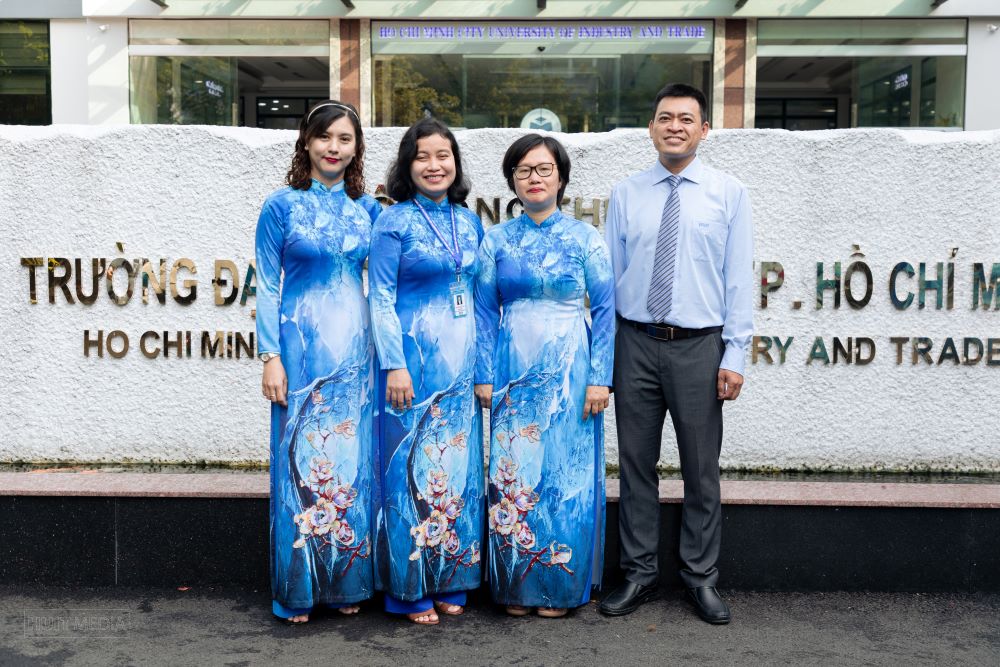
Department of Materials Technology
1. OVERVIEW OF THE DEPARTMENT
The Department of Materials Technology is assigned by the Faculty to manage specialized courses in materials engineering. The Department currently offers the academic program in Materials Technology.
The Department has 06 full-time lecturers, including 02 Associate Professors, 01 PhD holder, 02 PhD candidates, and 01 MSc holder. Each year, the Department supervises graduation projects for approximately 50 undergraduate students and 5 graduate students.

Assoc. Prof.Dr. Huỳnh Lê Huy Cường
Head of Department
 Assoc. Prof.Dr. Nguyễn Học Thắng
Lecturer

Dr. Giang Ngọc Hà
Lecturer

Dr. Hồ Thị Ngọc Sương
Lecturer

Dr. Nguyễn Ngọc Kim Tuyến
Lecturer

MSc. Nguyễn Hưng Thủy
Lecturer
2. ACADEMIC SPECIALIZATION
The Department delivers advanced courses in the Materials Technology program, consisting of two academic concentrations:
Polymer and Composite Materials
Specialized courses include:
· Polymer and Composite Materials
· Polymer Additives
· Advanced Polymer Materials
· Nanomaterials
· Plastic Processing Technology
· Plastic Packaging
· Rubber Processing Technology
· Paint Production Engineering
· Adhesive Technology
· Plastic Mold Design
· Plastic Product Design
· Polymer Analysis and Evaluation Methods
Silicate Materials
Specialized courses include:
· Ceramic Engineering
· Glass Technology
· Cement Technology
· Construction Materials
· Refractory Material Manufacturing
· Advanced Silicate Materials
· Ceramic Coatings
· Inorganic Pigments
The Department also supervises internships and undergraduate thesis projects for students majoring in Materials Technology, as well as students from other Chemical Engineering programs.
3. RESEARCH AREAS
· Modification of polymer and composite materials for coatings and waterproofing applications
· Development of anti-corrosion coatings and water-based environmentally friendly paints
· Synthesis of nanomaterials and catalytic materials for environmental treatment
· Enhancing mechanical and thermal properties of polymer composites reinforced with nano fillers (silica, clay, etc.) and other additives; application in polyurea, epoxy and protective coatings
· Development of inorganic–silicate materials
· Waste treatment and recycling
· Environmentally friendly composite materials
· Materials for food preservation
· Development of polymer and composite materials (hydrogels, superabsorbent polymers, rubber, nanocomposites)
· Research on superhydrophobic surfaces
· Micro- and nano-encapsulation technology (emulsion stabilization, nano/micro-emulsion)
· Analytical techniques: gelation time, contact angle measurement
· Photorefractive polymers, nonlinear optical (NLO) chromophore synthesis, and photoconductive polymers
· Photocatalytic materials and applications
· Ceramic glazes and inorganic pigments
· Emulsion alkyd resin synthesis using phase inversion theory
· Core–shell structured styrene–acrylic emulsion polymer synthesis
· Green catalysis for polycondensation polymer synthesis
· Utilizing recycled plastics for polymer film-forming materials
· Critical PVC value determination for heat-resistant coatings
· Fabrication of hollow-colored rubber products
· Application of polymer composite theory to produce green composite materials and composite products using BMC, SMC, RTM technologies