

Development of Bio-Based Hydrogels from Shrimp-Shell Chitosan
DEVELOPING BIO-BASED HYDROGELS FROM SHRIMP-SHELL CHITOSAN: A SUSTAINABLE APPROACH TO BIOMEDICAL AND ENVIRONMENTAL MATERIALS
In response to the growing demand for environmentally friendly materials with high application value, a research team from the Faculty of Chemical Engineering at Ho Chi Minh City University of Industry and Trade conducted an in-depth study on naturally derived bio-based hydrogels using chitosan extracted from shrimp shells—an abundant source of seafood waste in Vietnam. The study was published in the Journal of Applied Polymer Science (Wiley, 2025), demonstrating the scientific quality and international recognition of the research.
Hydrogels are three-dimensional polymeric materials capable of absorbing and retaining large amounts of water while maintaining their structural integrity. Owing to these properties, hydrogels have been widely applied in biomedicine, food packaging, environmental treatment, and smart materials.
In this study, the researchers developed a composite hydrogel system consisting of three natural polysaccharides: chitosan, alginate, and carrageenan. All three components are biologically derived, biodegradable, and highly biocompatible.
A key highlight of the study was the conversion of discarded shrimp shells into chitosan with very high water solubility of over 92% through a mild and environmentally friendly treatment using acetic acid and hydrogen peroxide. The resulting chitosan exhibited a high degree of deacetylation of 94.2%, making it particularly suitable for forming a stable and homogeneous hydrogel network. The utilization of seafood waste not only helps reduce environmental burdens but also contributes to the development of a circular economy model in the materials sector.
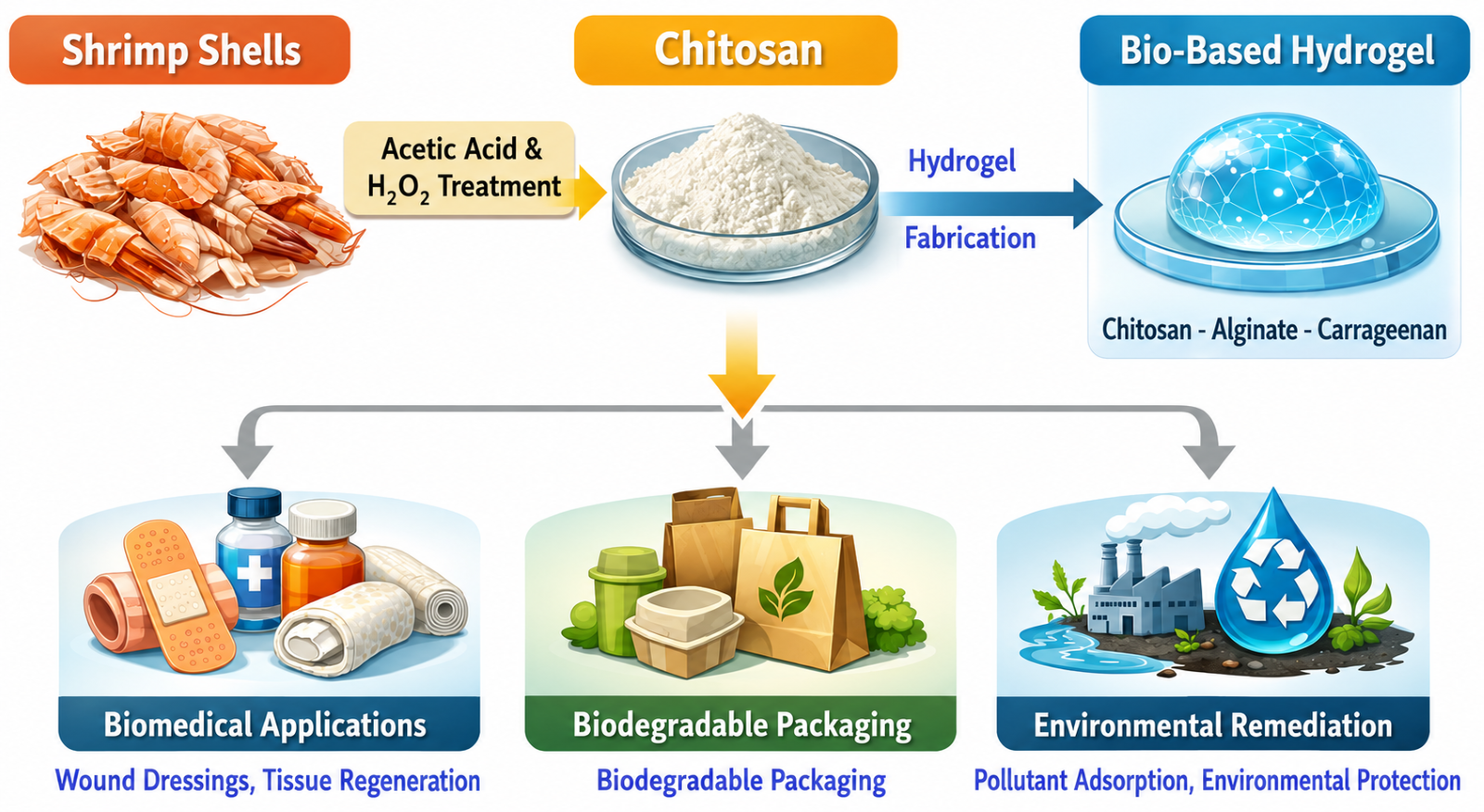
Figure 1. Schematic illustration of shrimp-shell processing for the production of hydrogel materials with applications in various fields
The hydrogel samples were synthesized using chitosan contents ranging from 0.5 to 1.5 g, while the amounts of alginate and carrageenan were kept constant. The results showed that the hydrogel containing 1.0 g of chitosan, designated as M3, exhibited the most favorable overall properties, achieving an effective balance among structural characteristics, mechanical performance, and biological functionality.
The M3 hydrogel achieved a high tensile strength of 5.3 MPa, a Young’s modulus of 6.5 GPa, and an outstanding swelling capacity of over 1,200% under neutral pH conditions. It also exhibited nearly zero solubility, indicating the formation of a highly stable polymer network.
In addition to its excellent mechanical properties, the M3 hydrogel demonstrated remarkable biological activity. Its antioxidant activity reached 94.55% after 120 hours, indicating considerable potential for cellular protection and biomedical applications. In particular, the hydrogel exhibited very high antibacterial effectiveness against both Gram-negative bacteria (Escherichia coli) and Gram-positive bacteria (Staphylococcus aureus), with bacterial inhibition rates of approximately 99%. This property is particularly important for applications such as wound dressings, antibacterial food packaging, and medical materials.
Structural analyses using X-ray diffraction (XRD), Fourier-transform infrared spectroscopy (FTIR), and scanning electron microscopy (SEM) revealed that the hydrogel possessed a predominantly amorphous structure and a uniformly distributed microporous network. This porous structure facilitates water absorption, molecular diffusion, and the loading and controlled release of biologically active compounds. Ionic interactions and hydrogen bonding among the –NH₃⁺, –COO⁻, and –OSO₃⁻ functional groups play essential roles in the formation of a stable polymeric network.

Figure 2. Hydrophilic porous structure and high antibacterial and antioxidant activities of the chitosan–alginate–carrageenan-based hydrogel
The study is significant not only from a scientific perspective but also in terms of its practical value. It opens up considerable potential for applications in biomedical materials, biodegradable packaging, pollutant adsorption, and environmental technologies.
Furthermore, the research demonstrates the strong research capacity, commitment to green-material development, and international integration of lecturers and scientists at Ho Chi Minh City University of Industry and Trade. These achievements are expected to contribute to attracting prospective students and establishing new research collaborations in the future.
References
Nguyen Hoc Thang, Nguyen Van Phuc, Le Ngoc Han, Pham Nguyen Phuong Ngoc, and Tran Thi Tu Nhi (2024). Engineering properties of composite film from chitosan–alginate–carrageenan as antibacterial material. Chemical Papers, 79(2), 733–744.
Nguyen Van Phuc, Nguyen Hoc Thang, and Tran Le Anh Khoa (2025). Evaluation on effects of chitosan derived from shrimp shells on engineering properties, antioxidant, antibacterial, and microstructural characteristics of chitosan–alginate–carrageenan-based hydrogels. Journal of Applied Polymer Science, 142(32), e57278.
See more :
- ANNOUNCEMENT ON STUDENT CONDUCT SCORES FOR SEMESTER II, ACADEMIC YEAR 2025–2026 – FACULTY OF CHEMICAL TECHNOLOGY
- REGISTRATION FOR THE 2026 POSTHARVEST TECHNOLOGY COMPETITION
- Faculty of Chemical Engineering Student Named First Runner-up at Mister HUIT 2025
- PLASTICS MATERIALS TECHNOLOGY AND CAREER OPPORTUNITIES
- PROMOTING ACDEMIC ACTIVITIES AND STRENGTHENING THE LINK BETWEEN EDUCATION, SCIENTIFIC RESEARCH AND PRACTICE_FCE