

ECHEME_HUIT English Club Activity Report_FCE
ECHEME_HUIT has implemented a series of periodic academic activities following a systematic and continuous content roadmap. In parallel, the club has also organized in-depth consultation sessions to support students in developing and improving their English presentation skills, as well as in advancing chemical product development projects.
The first activity, held on January 31, 2026 via Google Meet, focused on introducing the club’s objectives, organizational structure, and regulations to all new members. This orientation session served as an important foundation, helping students begin their journey of learning English for Chemical Engineering in a structured and systematic manner.
The sessions on February 28, 2026 and March 13, 2026 were conducted via Microsoft Teams. These activities helped students strengthen their basic technical vocabulary in the field of chemistry and become familiar with common specialized language used in academic materials and international working environments. The sessions were delivered through contextual exercises closely connected to professional chemical engineering activities.
In its upcoming activities, ECHEME_HUIT will continue to focus on enhancing students’ ability to express specialized knowledge in Chemical Engineering, while creating opportunities for them to practice through real-life situations. Through this process, students are expected to gradually build confidence and competence in academic communication in English.
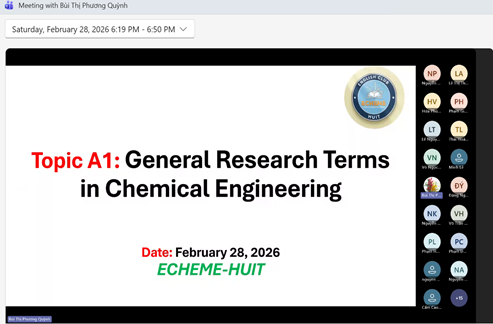
Figure 1. Topic of the academic session: General Research Terms in Chemical Engineering
English Presentation Activities on Chemical Product Development Ideas
As part of ECHEME_HUIT’s academic activities, members recorded English presentations on research projects proposed by the students themselves. This was a purposefully designed practice activity aimed at helping students develop both applied scientific thinking and specialized communication skills in an international language — a competency that is increasingly essential in the modern chemical industry.
A notable aspect of this activity is that all project ideas originated from the students themselves, reflecting their ability to observe real-world problems and proactively propose scientifically grounded solutions.
Featured Projects
Natural Skincare Product from Khaya senegalensis
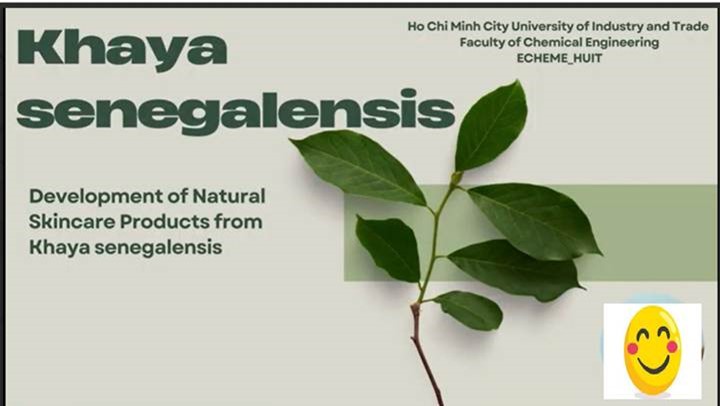
Figure 2. Opening slide of the presentation on the idea of developing a skincare product from Khaya senegalensis by students C.H.N. Cẩm and C.H.M. Cẩm, Class K16.
The student group proposed the idea of utilizing bioactive compounds from Khaya senegalensis — a plant commonly known in traditional medicine — to develop a natural cosmetic product. The presentation was delivered entirely in English and covered the scientific basis, extraction process, and potential practical applications of the proposed product.
Eco-Friendly Materials from Sunflower By-Products
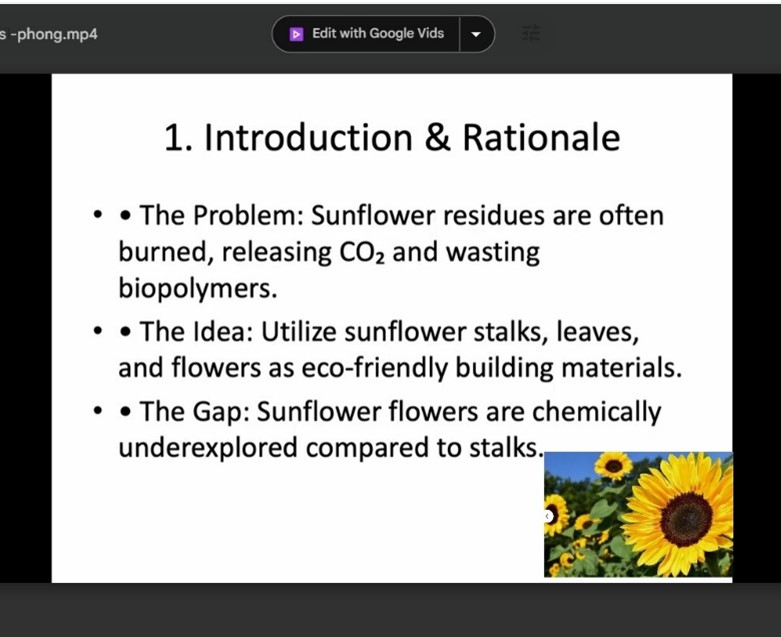
Figure 3. Slide introducing the idea of eco-friendly materials from sunflower by-products by students D.V.T. Thực and D.H.T. Phong, Class K16.
Based on the real-world observation that sunflower stems, leaves, and flowers are often burned after harvest — causing CO₂ emissions while wasting a valuable source of biopolymers — the student group proactively explored the possibility of reusing these agricultural by-products to produce environmentally friendly construction materials.
The group’s English presentation clearly demonstrated a circular economy mindset: transforming an environmental issue into an opportunity to create a product with high commercial value.
Bio-Based Materials from Coconut Husk for Food Packaging
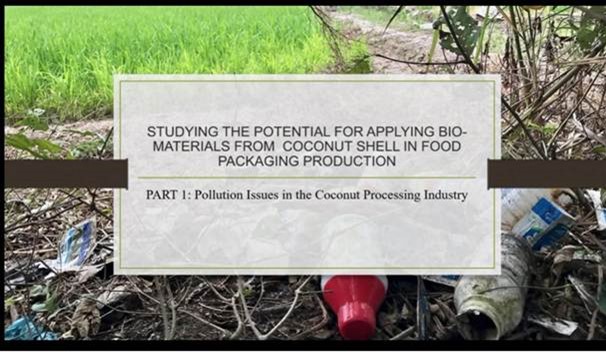
Figure 4. Title slide of the research project on bio-based materials from coconut husk, set in the context of pollution from the coconut processing industry, by students N.H.B. Nhi, Đ.T.H. Yến, and T.B. Băng, Class K16.
The students proposed the potential application of materials extracted from coconut husk as an alternative to single-use plastics in the food packaging industry. The idea was developed in the practical context of the coconut processing sector, where coconut husk waste remains an environmental issue that has not yet been fully addressed.
Through their English presentation, the group demonstrated the ability to connect a local environmental problem with global trends in sustainable materials, especially in the context of increasingly stringent regulations on plastics in many markets.
By the end of May 2026, ECHEME_HUIT had gradually supported students in establishing a continuous and clearly progressive learning pathway for specialized English. This pathway began with the development of technical vocabulary through regular academic sessions and advanced toward practical application through project presentation activities.
A key highlight is that students did not merely practice language skills; they also independently developed ideas, constructed scientific content, and presented their work entirely in English — from problem formulation and argumentation to the presentation of outcomes.
This represents an effective club activity model that integrates chemical expertise with international academic communication skills, providing students with a solid foundation to confidently enter the global working environment.
See more :
- WORKSHOP ON “OPPORTUNITIES AND CHALLENGES FOR WOMEN IN THE ERA OF GREEN TRANSITION” Mới
- BANANA FIBER _ A SUSTAINABLE BIO-BASED ALTERNATIVE TO SYNTHETIC FIBERS
- BANANA FIBER - A SUSTAINABLE BIO-BASED ALTERNATIVE TO SYNTHETIC FIBERS_FCE
- HUIT MATERIALS TECHNOLOGY STUDENTS PARTICIPATE IN INDUSTRIAL STUDY VISITS IN 2026
- ANNOUNCEMENT ON STUDENT CONDUCT SCORES FOR SEMESTER II, ACADEMIC YEAR 2025–2026 – FACULTY OF CHEMICAL TECHNOLOGY